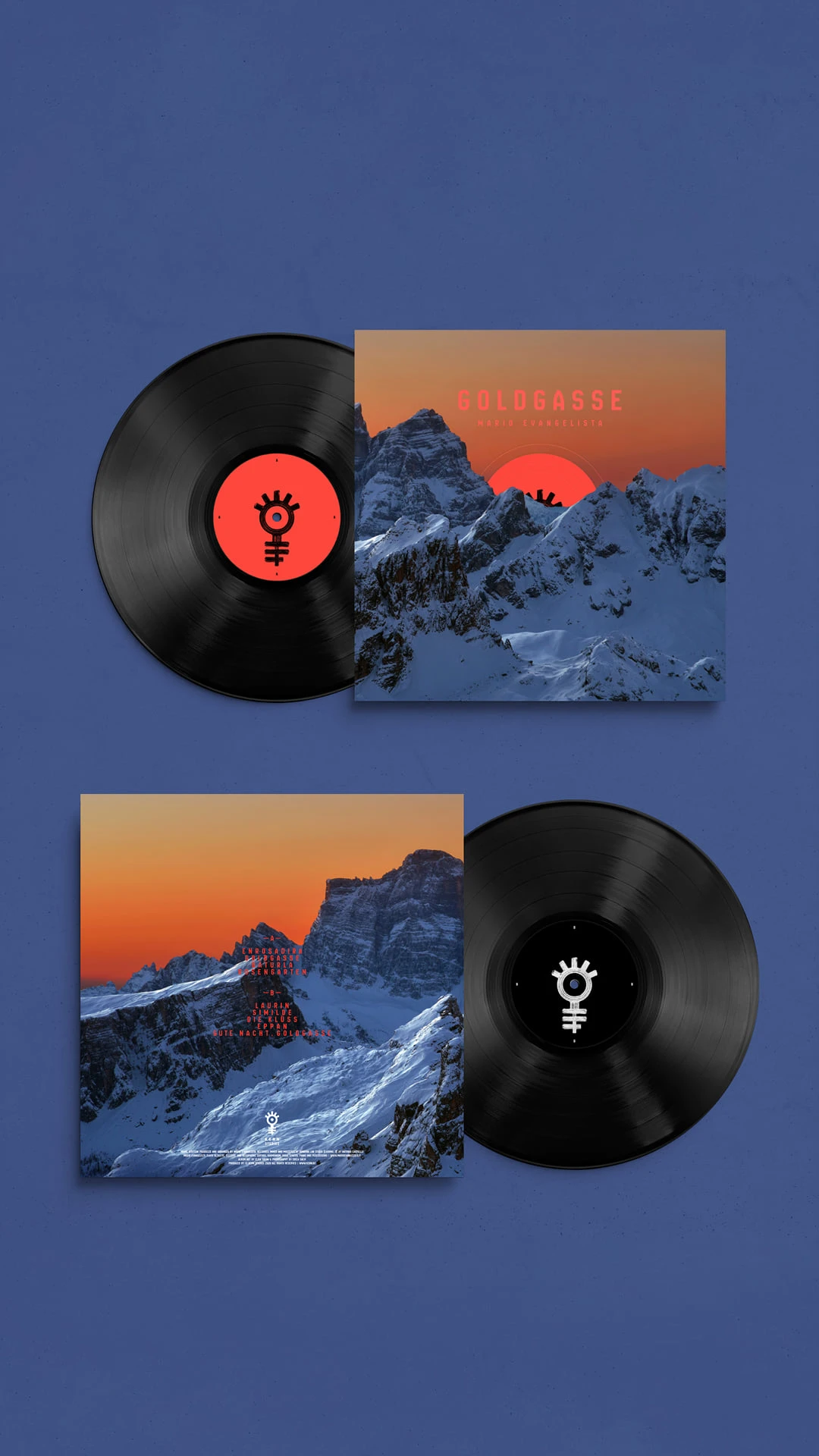
Album Goldgasse
Nine instrumental pieces, an ideal soundtrack for Goldgasse, our project in the heart of San Michele sulla Strada del
Vino. The sound of a place, before anyone lives in it.
before living
We asked Mario Evangelista to listen to a place before it really existed: the still-empty rooms of Goldgasse, the light shifting through the day, the silence. To stay there as
long as it took, and write down what he heard. With no constraints, no deadlines, and no idea where it would lead.

Nine instrumental pieces came out of it: the first album released by Kern Studios.
Listening to that place, Mario Evangelista went beyond the village. Inspiration also came from the legend of King Laurin and from the enrosadira, the pink that sets the peaks alight at dawn and at dusk. Every piece takes its name from the places and characters of that story. The only exception is Baturla, a word Mario brought with him from Florence, where he has lived for years: in Tuscan dialect it describes the rumble of clouds gathering into a storm, like giants brooding.
Listen on
We gave him the keys. He opened doors we didn’t know we had.
Mario Evangelista
For many years I had wanted to be involved in writing a soundtrack. When Kern got in touch it was a great surprise, because the commission opened up scenarios I hadn’t even imagined. So I composed instrumental pieces that would show a coherent, harmonious fusion of old and modern, exactly as in Kern’s own style. To do that I used every instrument I can play: synthesisers, acoustic and electric guitars, electric bass, pedal harmonium, pedal steel, percussion and more. Above all I focused on writing the pieces directly on paper, thinking first of their strong thematic and melodic identity and of a sound that would be meaningful to my own path. I wanted to bring in both the acoustic, “traditional” element of the guitar, as always in multiple tunings, and a certain kind of electronics, through synths and digital manipulation.


Laurin is the first single taken from Goldgasse, available on all digital platforms from 11 September 2026.
It takes its name from the king who, in the legend, guards a garden of roses at the foot of his mountains. It is those very roses that betray him: their red makes him visible to his enemies, who capture him. In revenge he casts a spell on the garden, so that no one may see it again, neither by day nor by night, but he forgets dawn and dusk. It is in those two moments that the roses return, and the Dolomites turn pink.
Mario Evangelista translated that image into music:

The piece is inspired by King Laurin, the figure at the heart of the most classic Dolomite legend. His stature is rendered by the relentless rhythm of the electric guitar which, working with delay, builds the sonic image of his footsteps shaking the earth. Over those steps comes his voice: a flute-like, magical synth theme that leaves room for the imagination and paints a character who is not only grandeur, but also depth.
9 doors

Enrosadira

Goldgasse

Baturla

Rosengarten

Similde

Die Klüss

Eppan

Gute Nacht,
Goldgasse
A musician, composer, arranger and multi-instrumentalist for over twenty years, Mario Evangelista plays resonator, electric and acoustic guitar in various tunings, pedal steel and lap steel, banjo, mandolin, ukulele, piano, Irish flutes and keyed bagpipes. He also works as a session player, sought after above all for his skills as an arranger and multi-instrumentalist.

Mario Evangelista
Photo by Lello Muzio
He is part of Collettivo Jambona, the group of musicians orbiting Antonio Castiello’s Jambona Lab Studio in Livorno. With the ensemble he won the Premio Ciampi 2025 and released Noi, Piero (Viceversa Records, 2026), dedicated to Piero Ciampi and runner-up at the Premio Tenco 2026 in the “Album a progetto” category.
With his band Pitchtorch he released the self-titled debut in 2019, named by Repubblica Firenze among the most interesting works of the year and placed by Roots Highway among the ten best Americana records made in Italy in the past decade, and I Can See The Light From Here in 2023, featuring Joachim Cooder, Beppe Scardino and Francesco Bigoni. He also plays with The Gutbuckets, with three records and a long presence on the Italian festival circuit, and has been a member of Riserva Moac, Radioscilla and Sousaphonix.
He has shared stage and studio with the Corsican band L’Alba, recording A Principiu (Buda Musique, 2021), honoured at Womex 2022 and welcomed by world music charts around the globe. He has long produced records for other artists, work that has taken him to the finest Italian and international studios, as far as Abbey Road Studios in London, where he completed The Calling by LaDom In Florence.
On 15 May 2026 he released Da Capo, an instrumental album devoted to his many influences: the musicality of Corsica, the blues of Mali, Irish folk. Goldgasse is the record that follows, recorded like Da Capo at Jambona Lab Studio with Antonio Castiello.

All music written,
produced and arranged by
Mario
Evangelista
Recorded, mixed and
mastered by
Antonio
Castiello
Recording Studio
Jambona
lab studio
Creative direction and
artwork by
Elisa
Bruni
Photography by
Erica
Salvi
Mario Evangelista plays acoustic, electric and resonator guitar, harmonium, bass, synthesisers, piano and percussion.
Produced by © Kern Studios 2026 All rights reserved

